
EQUALITY HAS A CONSTANT
Read More >>
Universal Constant
“Equality has a Constant!”
Overview 》
Definition
Equilibrium of sow and reap; cause and effects; intent and outcome; efforts and results; input and output; or any other similar equated constructs.
Description
The foundational constant that connects all underlying factors that relate to equality. It provides the basis for a dynamic architecture that is highly reliable. Thus making the Protocols Of Equal logically unified, and mathematically stable.
Summary
In the Protocols of Equal Institute equality is observed as having a foundational constant, the Rule of Sow And Reap (ROSAR).
Logical Premise 》
Society is not formed by randomized events. On the contrary, society is formed and operated via calculated intent. The majority of actualized things and experiences within society, exhibits a preceding calculative intent. Ultimately, society is defined by intent weighed by its corresponding outcome.
Within the POE framework intent is interchangeably defined as, seed. To sow is the act of planting a seed, or intent.
The prefix equ and equi are rooted in concepts associated with balancing, weighing, leveling, and achieving equilibrium. Equality, equity, equilibrium, equivalence, and equanimity all originate from the same fundamental notion that multiple conditions must be evaluated in relation to one another. Hence, all these “Equ” concepts and their derivatives inherently exhibit a certain innate symmetry. The POE considers this an accurate definition of equality.
Thus, monitoring intent and the processes that lead to outcomes is vital to ensure circumstances are equitable.
Axioms
Traceability: Every outcome shall possess one or more traceable pathways linking it to its originating intent.
Progression: Between sowing and reaping exists an observable progression governed by interacting constructs, principles, factors, and variables.
Causal Integrity: The integrity of the sow and reap relationship determines whether progression remains equitable or becomes inequitable.
Equilibrium: Equality exists when the relationship between sowing and reaping remains proportionate, balanced, and unobstructed throughout an occurrence.
Symmetry: Every equality evaluation requires the symmetrical comparison of related conditions, intents, actions, and outcomes.
Equated Relationship: Equality cannot be determined from isolated constructs alone but through the comparison of equated relationships.
Continuous Evaluation: The Rule of Sow And Reap governs every stage of progression from intent to outcome.
Universality: The Rule of Sow And Reap applies consistently across all conduits, occurrences, entities, and societal domains.
Significance 》
As nearly everything in society is weighted by intent and outcome, it places the Rule of Sow And Reap (ROSAR) at the micro foundations of most interactions.
Based on the observations of the POE, the vast majority of inequalities; and potentially all inequalities, occur due to the breaking of the The Rule of Sow And Reap (ROSAR). This provides a strong argument for the ROSAR as a foundational constant. One that is scalable from micro foundations to macro universal applications. For instance:
- Oversight of the formation of the Map Of Sow And Reap Constructs (MOSARC)
- It enables the detection of the Breaking Point Of Equality (BPOEQ).
- The status & progress of equality or inequality
- Accreditation of the apex of equality or inequality
- Methods to reverse the resulting inequities
- Establish strategies to prevent the occurrence of potential inequalities.
- Unify equality via one scalable framework
- A foundational element that is applicable in any industry or context.
Those are just some of the features of the ROSAR.
Mechanics 》
Based on the “Logical Premise”, most actions consist of an intent to outcome relationship.
Every occurrence consists of one or more intent (sowing) that introduces one or more inputs into an occurrence or system. These inputs progress through a sequence of interactions before producing corresponding outcomes (reaping).
This process of intent (sow) and outcome (reap), involves conduits, occurrences, principles, factors, and variables.
Conduits provide the domain in which sowing and reaping occur.
Occurrences define the observable event.
Principles modify the process of sow and reap.
Factors influence principles.
Variables introduce contextual differences.
All of these are thoroughly explained later in this Technical Specification.
Equality is maintained when the sowing and reaping relationship remains proportionate, consistent, and unobstructed throughout the entire process.
When this relationship becomes hindered, interrupted, delayed, distorted, or redirected, inequality emerges.
The Rule of Sow And Reap (ROSAR) is the foundational constant that connects, and underwrites this entire process of equality. As a result, it becomes possible to determine if a particular process is equitable or inequitable.
For simple observations of occurrences, the progression can be observed and interpreted via human readable format.
For complex observations involving numerous interconnected occurrences, the POE’s symmetrical architecture enables these interactions to be represented computationally, supporting quantitative analysis, and mathematical modeling.
Examples 》
| Conduits (Macro) provide the domain in which sowing and reaping occur.↓Occurrences (Meso) define the observable event.↓Principles (Micro) modify the process of sow and reap.↓Factors (Nano) introduce contextual differences.↓ | Throughout the entire process the Rule of Sow And Reap (ROSAR) is connected to all the above constructs of sow and reap. Variables introduce contextual differences to each of the constructs of sow and reap |
Affirmations 》
The above reasoning exemplifies why the Rule of Sow And Reap (ROSAR) is considered a universal constant and the defining aspect of “equal” and its dependent concepts such as equality and equity.
Rebuttals (The POE is more powerful than you think) >>
Previous Generations or Circumstances
“It doesn’t account for the factors of previous circumstances, or generations that contributed to the occurrence”
The Rule of Sow and Reap (ROSAR) is time- and culture-agnostic. This means it can be applied to past, present, and future generations. It is a constant that weighs human behaviors objectively, regardless of existing power structures.
This objectivity, paired with the principle of instantiation (INOSARs), enables the POE to calculate the Equality Quotient of past generations. Thus, making it possible to compare a past generation or circumstance with a new generation or circumstance. Any differences are weighed and calculated, and Actionable Protocols can be formulated to reconcile the variances.
ROSAR does not assume that an outcome is simply deserved because of what an individual or group has “sown.” Rather, it recognizes that every occurrence has preceding conditions, actions, decisions, structures, or inputs that contribute to its resulting yield. These relationships can therefore be examined, measured, and evaluated for equitability.
ROSAR Causal Chain:
Seed / Intent → Action → Occurrence → Consequence → Yield → Measurement → Equality Assessment → Actionable Protocol → New Yield
This enables the POE to analyze not only current circumstances, but also the relationships and conditions that produced them.
Nuances of Human Behaviors
“The POE doesn’t account for the nuances of human behavior and interactions”
The Rule of Sow and Reap (ROSAR) can be granularized to a depth that accounts for the cadence of individual human behaviors and the nuances of their integration with collective behaviors.
This can be accomplished at highly precise levels, yielding precise measurements and calculations of occurrences that reflect real-world human behaviors.
To reiterate, ROSAR enables the POE to assess the foundations of human interactions and quantify whether they are equitable or not, while factoring in the nuances of human behavior.
This is what makes the Rule of Sow and Reap a potentially universal principle: its application can extend from individual actions to collective behaviors, institutions, systems, and intergenerational circumstances.
Universal Constant
“It’s bold to claim the Rule of Sow and Reap is a universal constant.”
The ROSAR simply has an extremely high degree of application to both human-made society and natural mechanics. Many things that occur exhibit a relationship between an initiating action, condition, or intent and a corresponding outcome.
Even Newton recognized a comparable relationship within the physical world.
Newton’s Third Law of Motion:
“For every action, there is an equal and opposite reaction.”
Newton’s Third Law provides a physical analogue for ROSAR: actions produce corresponding reactions. While Newton’s law describes physical interactions and does not establish the equitability of an outcome, it demonstrates a broader principle in which an action and its resulting response are related.
Therefore, Newton’s Third Law does not itself prove that ROSAR is a universal constant. Rather, it provides a compelling physical parallel to the sow-and-reap relationship.
This raises the possibility that the application of ROSAR could eventually evolve beyond its current societal applications into other areas of natural mechanics.
Assessment vs. Calculation
“Equality is not a computation; it’s a human right.”
Equality is a human right. However, the conditions through which equality is achieved can be assessed or calculated.
Assessment
When equality is merely assessed, there may be limited assurance of accuracy, objectivity, depth, or efficacy of application.
Currently, equality is predominantly assessed. This is one reason why it can be difficult to consistently measure conditions of inequality and determine whether interventions are actually producing equitable results.
Assessment asks:
“Does this appear equitable?”
The affected should not have to rely solely on assessments that cannot be adequately validated for their effectiveness.
Calculation
As a reminder, the Rule of Sow and Reap (ROSAR) is a highly moral and ethical concept. Yet it also possesses the capacity to support the calculation of equality.
Calculation takes much of the guessing out of equality analysis. It is a primary enabler that makes it possible to evaluate equality at greater depths.
Through Quantifiable Parameters, the POE can generate considerable numbers of Dynamic Data Points that can be used for increasingly detailed and reliable calculations.
Calculation asks:
“To what measurable degree is this equitable, under what parameters, and based on what evidence?”
Therefore, the POE takes the position that equality is not only something that can be assessed—it can also be quantified where appropriate, and quantification is necessary for meaningful validation.
If equality is intended to produce measurable equitable outcomes, shouldn’t those outcomes be capable of being measured and validated?
Policy vs. Agency
“Equality isn’t for the purpose of giving people personal agency; it’s for fairness.”
Policy
Currently, many equality efforts stop at policy and initiatives that lack substantial depth of execution.
Although policy is important, it is usually overarching and cannot always be reliably measured at the level where people actually experience its effects.
A policy can state an intention to produce equality without demonstrating that the intention is being consistently translated into equitable outcomes.
This raises fundamental questions:
- Was the policy implemented?
- Was it implemented by the right individuals?
- Was it implemented consistently?
- Did implementation produce the intended outcome?
- How will equitability be calculated?
Agency
ROSAR extends beyond policy into agency.
Agency can exist at both the:
- Individual level
- Collective level
The individual or collective experiencing a circumstance provides the initial seed, intent, effort, or action. ROSAR then provides a basis for evaluating the resulting yield and determining whether adequate agency exists to achieve the intended goal.
Where sufficient agency does not exist, Actionable Protocols can identify the conditions, interventions, or actions necessary to increase the individual’s or collective’s ability to achieve that goal.
Thus, agency is not the purpose of equality; rather, agency can be one of the mechanisms through which equitable outcomes are achieved and validated.
ROSAR Within the POE Measurement Loop
ROSAR can function as the causal principle underlying the POE’s broader analytical process:
Observe → Map → Measure → Compute → Improve → Validate → Repeat
ROSAR establishes the relationship between what is introduced into a circumstance and what ultimately results from it.
The POE then applies its analytical process to:
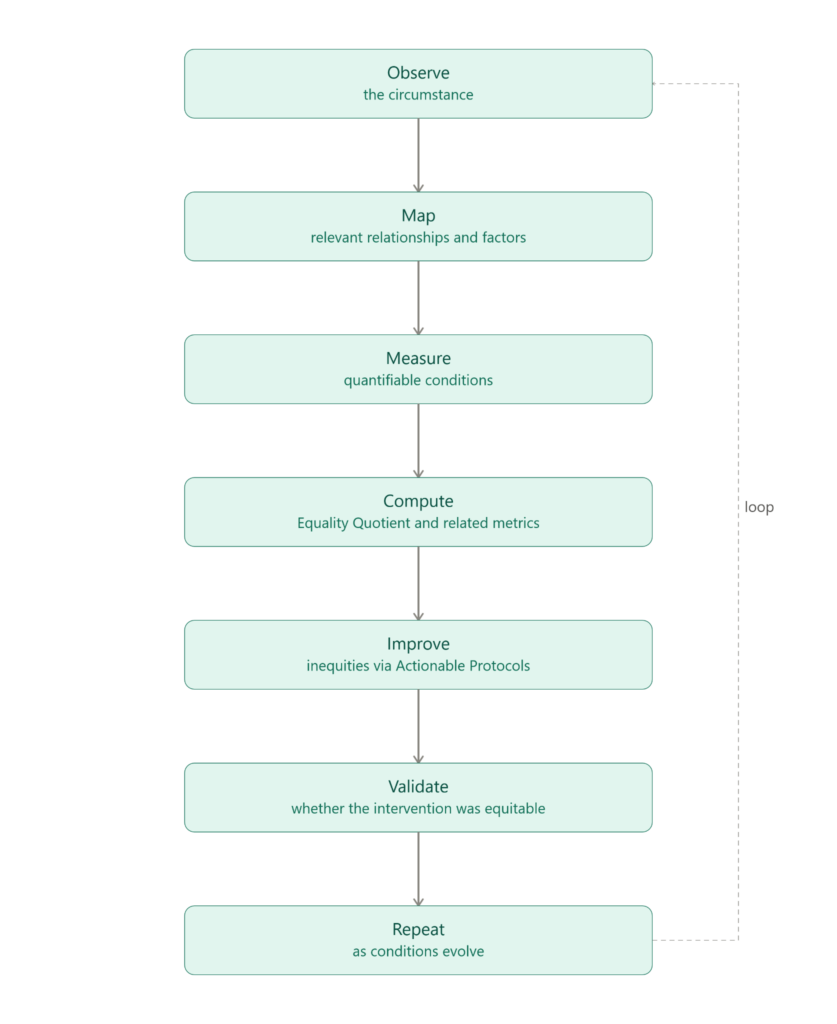
This transforms ROSAR from a philosophical or moral proposition into an operational principle capable of supporting systematic equality analysis.
The fundamental proposition is therefore:
What is sown establishes conditions for what is reaped; ROSAR provides a framework for examining that relationship. This enables the POE to measure, calculate, validate, and improve its equitable outcomes.
INSTANCE OF SOW AND REAP (INOSAR)
Read More >>
Overview 》
Definition
An Instance of Sow And Reap (INOSARs) is the emanation of a group of circumstances that affect the process of sow and reap.
Description
INOSARs possess the majority of and potentially, all equality related details directly connected to a particular circumstance. Enabling the successful observation of a particular process of sow and reap from emanation, to either actualization or termination.
Summary
How!? Each instance includes the entire Map Of Sow And Reap Constructs (MOSARC). Therefore, every Instance of Sow And Reap (INOSAR) can within itself, successfully map all equality related factors and variables associated with its own unique iteration.
Logical Premise 》
Each Instance of Sow And Reap (INOSAR) captures all interaction related to the process of sow and reap. This becomes an independent analytical record, enabling the POE to build a comprehensive, searchable, and evidence based repository of equality related circumstances.
Thus, each Instance of Sow And Reap can provide substantial details about the interaction of its inherent constructs. Potentially, creating a detailed information repository of a particular circumstance.
Instances can be individuals or collective. There can be many instances co operating and correlated within a particular environment. In theory, an individual or collective can be part of many INNOSARs.
Axioms
Instance: Every INOSAR represents a unique sown and reap relationship.
Capture: Every INOSAR records the constructs and interactions influencing an occurrence.
Context: Every INOSAR exists within an identifiable environment.
Participation: Individuals and collectives may participate in multiple INOSARs.
Aggregation: Multiple INOSARs collectively reveal larger equality patterns.
Evaluation: Every INOSAR can be evaluated through ROSAR.
*Axioms will evolve to have standardized categories that will be utilized by each construct of the framework.*
Significance 》
INOSARs and the MOSARC, enable the detection of circumstances related to the process of sow and reap at inception. At which point they can be thoroughly inspected, quantified, indexed, and converted into actionable protocols that:
- Achieve equality, or as the POE describes it: actualization of sow and reap.
- Reverse and prevent inequality, or as the POE describes it: termination of the hindrances of sow and reap.
Instances of Sow And Reap empowers a dynamic architecture that can support complex extensions. The result is structured inheritance with powerful recursive abilities.
Mechanics 》
Each instance includes the entire Map Of Sow And Reap Constructs (MOSARC). Therefore, every Instance of Sow And Reap (INOSAR) can within itself, successfully map all equality related factors and variables associated with its own unique iteration. Thus, each Instance of Sow And Reap can provide substantial details about the interaction of its inherent constructs. Potentially, creating a detailed information repository of a particular circumstance.
Examples 》
Once an occurrence of sow and reap is detected, the INNOSAR becomes activated. The MOSARC then:
- Locates the exact occurrence (meso construct)
- Determine the conduit (macro construct)
- Determine the primary principle being utilized (micro construct)
- This produces Quantifiable Parameters
- Actionable Protocols are formed to either actualize the process of sow and reap or terminate the hindrance of sow and reap.
Affirmations 》
INOSARs enable the successful observation of a particular process of sow and reap from emanation, to either actualization or termination. This oversees both the commencement or termination of equality or inequality. Instances of Sow And Reap are a foundational component of the Protocols of Equal, and perhaps a vital contribution to the advancement of equality.
Map Of Sow And Reap Constructs (MOSARC)
Read More >>
Overview 》
Definition:
The Map Of Sow And Reap Constructs (MOSARC) reveals the constructs of the process of sow and reap along with their underlying factors and variables.
Description:
The MOSARC makes it possible to map, pinpoint, and track the underlying factors and their associated variables that affect the process of sow and reap.
Summary:
The MOSARC provides deep insights, with clarity. Potentially generating many details for analysis.
Logical Premise 》
Equality must be mapped before it can be measured, understood, reversed, or improved.
MOSARC identifies and organizes the constructs that influence the progression from sowing actions to reaping outcomes.
Every sow and reap relationship is produced through interacting constructs that must be identified and analyzed.
Understanding the roles of conduits, occurrences, principles, factors, and variables enables the POE to determine how equality is created, maintained, disrupted, or restored.
Accurate mapping of equality constructs enables targeted prevention and corrective action.
By revealing the relationships and points of influence within a process, MOSARC allows inequitable patterns to be traced to their source and addressed before they produce further consequences.
Axioms
Mapping Axiom
Equality must be mapped before it can be measured, understood, or improved.
Construct Axiom
Every sow and reap relationship consists of identifiable constructs that influence its progression.
Relationship Axiom
Equality outcomes emerge from the interaction between interconnected constructs.
Traceability Axiom
Every equality outcome must have identifiable pathways connecting causes, influences, and consequences.
Intervention Axiom
Accurate mapping enables targeted prevention, correction, and restoration of equality.
Significance 》
The Map Of Sow And Reap Constructs (MOSARC) makes it possible to have quantifiable parameters. It provides a foundational basis to underwrite equality across many contexts. A critical component required for the interconnection of sow and reap constructs. The primary purpose of the MOSARC is to quantify all possible aspects that affect equality with enough precision to form equations without any remainders. Although this is a highly ambitious aspiration, it is one that is attainable.
Mechanics 》
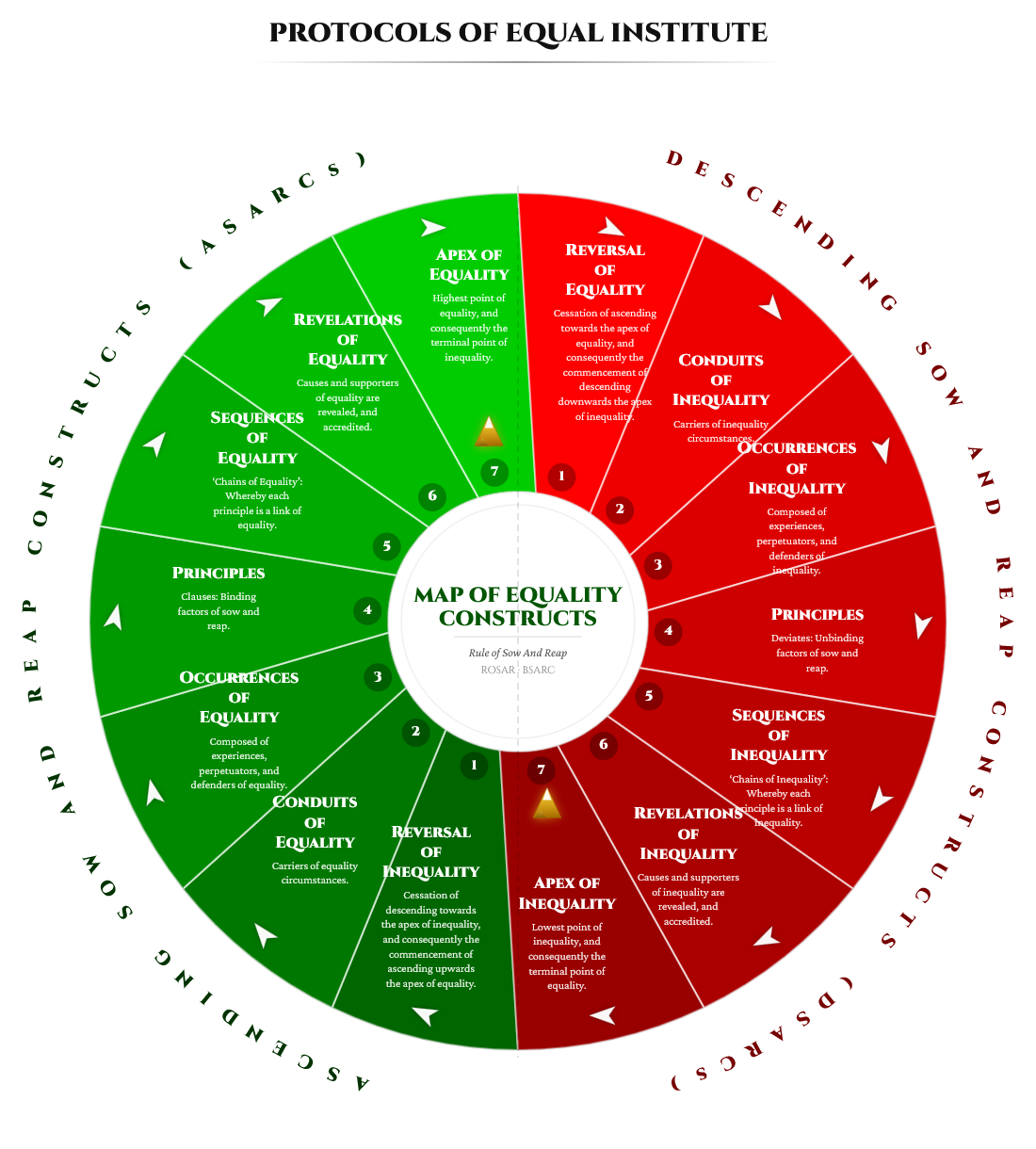
The MOSARC is comprised of:
- Two polarized chains:
- Ascending Sow And Reap Constructs (ASARCs) are progressions that aspire towards the Rule of Sow And Reap (ROSAR)
- Descending Sow And Reap Constructs (DSARCs) are regressions that deviate from the ROSAR
- A large database consisting of: Conduits, occurrences, principles and factors.
- Floating constructs: Breaking point, revelation point, reversal point. Each of which are formulated by at least 1 principle, or a sequence of principles.
- An end point: The Apex point.
This renders equality as foundational, structured, and now quantifiable. It transforms equality from overarching nostalgic pursuits, into quantifiable processes. Ones that can give rise to protocols with actionable insights that produce measurable results.
| Equality PathEqual Opportunity↓Equal Participation↓Equal Outcomes↓Social Stability | Inequality PathUnequal Opportunity↓Restricted Participation↓Unequal Outcomes↓Social Instability |
Affirmations 》
The MOSARC validates the Protocols Of Equal as a logically unified and mathematically consistent framework. Thus, making the POE an equated model.
Symmetrical Polarity Construct
Read More >>
Ascending and Descending Sow And Reap Constructs
Summary 》
Definition:
The Symmetrical Polarity Construct is a conceptual structure that encapsulates both symmetry and polarity via 2 opposing halves; Ascending Sow And Reap Constructs (ASARCs), and Descending Sow And Reap Constructs (DSARCs).
Description:
Ascending Sow And Reap Constructs (ASARCs) are progressions that aspire towards the Rule of Sow And Reap (ROSAR). Descending Sow And Reap Constructs (DSARCs) are regressions that deviate from the Rule of Sow And Reap (ROSAR).
Summary:
The organization of sow and reap constructs into two separate and polarized halves creates symmetry within the POE framework. In addition, it appropriately separates the “Eq Constructs” via polarity. Ie. input vs output.
Significance 》
This distinction of symmetry and polarity is what generates quantifiable parameters. A feature that hones in on the process of sow and reap to yield reliable calculations.
The perfectly symmetrical design of the POE makes it an equated model. Both Ascending & Descending constructs have the exact same Base Sow And Reap Constructs (BSARCs). Thus, every Ascending Sow And Reap Construct has an opposing Descending Sow And Reap Construct.
This unique ASARC / DSARC relationship houses the polarity of the equated constructs via opposing pathways such as:
- Sow ↔ Reap
- Intent ↔ Outcome
- Input ↔ Output
- Efforts ↔ Results
- Cause ↔ Effects
In addition, sub pairs of polarity such as:
- Opportunity ↔ Restriction
- Inclusion ↔ Exclusion
- Empowerment ↔ Disempowerment
Accordingly, equated constructs can be analyzed through a common structural reference.
This establishes the POE fully symmetrical and polarity based framework. Thus, appropriately defined as an “Equated Model”.
Logical Premise 》
ASARCs and DSARCs provide a way to distinguish the values of the polarity based pairs of the equated constructs. In addition, it provides an accurate means of determining the directional flow of the constructs and their inherent components.
Polarity Identification
Every equality related construct contains the potential for both an ascending (equality) and descending (inequality) progression. ASARCs and DSARCs provide the structural distinction necessary to identify whether a construct contributes toward equality or inequality. By identifying polarity, the POE can classify the directional nature of sow and reap relationships.
Directional Flow
Equality is not only determined by the presence of constructs but by the direction in which those constructs influence progression. ASARCs and DSARCs provide a method for tracing whether interactions, decisions, and outcomes move toward equality or inequality. This directional analysis enables the POE to evaluate the trajectory of constructs throughout an occurrence.
Construct Symmetry
Every equated construct requires a corresponding polarity based counterpart to accurately represent its complete range of possible outcomes. ASARCs and DSARCs establish a symmetrical framework for comparing constructive and destructive pathways within the same domain. This symmetry enables consistent measurement, comparison, and evaluation of equality progression.
Axioms
Polarity: Every Equated Construct possesses the potential for both ascending and descending expressions.
Dual Expression: Every Equated Construct may produce an ASARC and DSARC representation.
Equated Origin: Every ASARC and DSARC originates from a shared Equated Construct (EqCon).
Opposition: ASARCs and DSARCs represent opposing directional expressions of the same underlying Base Sow And Reap Construct (BSARC) such as Principles, or Occurrences.
Symmetry: Every ASARC has a corresponding DSARC counterpart.
Classification & Direction: ASARCs classify progression toward equality while DSARCs classify progression toward inequality.
Evaluation: ASARC and DSARC relationships enable measurement of equality progression.
Correspondence: ASARC and DSARC pairs derived from the same Equated Constructs correspond, and correlate with each other.
Progression: Constructs may transition between ascending and descending states depending on changing conditions.
Transformation: Interventions may transform descending progressions into ascending progressions.
Measurement: ASARC and DSARC relationships enable quantifiable equality analysis.
Balance: The relationship between ascending and descending constructs determines the equality state.
Mechanics 》
Ascending Constructs progress towards achieving equality, while simultaneously desisting and potentially terminating inequality. In contrast, Descending Constructs are negating equality, while simultaneously assisting and potentially perpetuating inequality.
However, while they have the same operational objective, they have opposing aspirations and subsequently directional flow.
EQU (Opportunity)
│
┌────────────┴────────────┐
▼ ▼
ASARC DSARC
(Equal Access) (Restricted Access)
Examples 》
| BASE SOW AND REAP CONSTRUCTS (BSARCs) | ASCENDING SOW AND REAP CONSTRUCTS (ASARCs) | DESCENDING SOW AND REAP CONSTRUCTS (DSARCs) |
| CONDUITS A carrier of sow and reap or the lack of it. They may not be the cause, however, they are the median that enables inequality to be manifested. Conduits can be seen as the server of circumstances associated with sow and reap. | Conduits of Equality (COEQ) Carriers of equality circumstances. | Conduits of Inequality (COI) Carriers of inequality circumstances. |
| OCCURRENCES All occurrences require a Conduit to ‘occur’. An occurrence is a manifested incident of sow and reap. Occurrences have several inherent components such as: experiences, perpetuators, defenders, reversals, and prevention. | Occurrences of Equality (OCOEQ) Composed of experiences, perpetuators, and defenders of equality. | Occurrences of Inequality (OCOEQ) Composed of experiences, perpetuators, and defenders of inequality. |
| PRINCIPLES Foundational component of an observed phenomena that interact with, and potentially affect the Rule of Sow And Reap (ROSAR). ‘The Links’, on the chains of equality or inequality. | Clauses: Binding factors of sow and reap. | Deviates: Unbinding factors of sow and reap. |
| APEX (Point / Sequence)The destination point of a conduit or occurrence of sow and reap. Conversely, the terminal point of its opposing ideology. | Apex of Equality (APEQ) Highest point of equality, and consequently the terminal point of inequality. | Apex of Inequality (APOI) Lowest point of inequality, and consequently the terminal point of equality. |
| BREAKING POINT (Point / Sequence)The specific point where the cessation of the directional flow towards the Apex Point of an Ascending or Descending Sow And Reap Construct. Thus, ‘Broken’. | Breaking Point of Equality (APEQ) The specific point where the directional flow towards the Apex of equality has stopped. Thus, broken. There is often a reason for this. Usually accompanied by a corresponding sequence. | Breaking Point of Inequality (APOI) The specific point where the directional flow towards the Apex of inequality has stopped. Thus, broken. There is often a reason for this. Usually accompanied by a corresponding sequence. |
| REVELATION (Point / Sequence)A point where causes and potentially supporters of a conduit or occurrence are revealed.*Variable Point* | Revelations of Equality (RevelOEQ) Causes and supporters of equality are revealed. | Revelations of Inequality (RevelOI) Causes and supporters of inequality are revealed. |
| REVERSAL (Point / Sequence)The reversal of the directional flow of an Ascending or Descending Sow And Reap Construct.*Variable Point* | Reversal of Equality (ReverOEQ) Cessation of ascending towards the apex of equality, and consequently the commencement of descending towards inequality. | Reversal of Inequality (ReverOI) Cessation of descending towards the apex of inequality, and consequently the commencement of ascending towards equality. |
| SEQUENCES The integral formation of multiple interrelated principles that contribute to the manifestation of a construct of sow and reap. ‘The Chains’ | Sequences of Equality (SOEQ)‘Chains of Equality’: Whereby each principle is a link of equality. | Sequences of Inequality (SOI)‘Chains of Inequality’: Whereby each principle is a link of inequality. |
IE. Opportunity (Equ)
ASARC:
A person receives fair access, support, and resources that allow their effort to translate proportionately into outcomes.
DSARC:
A person faces unnecessary barriers where their effort does not reasonably translate into equivalent outcomes.
Affirmations 》
ASARCs and DSARCs establish the directional architecture required for evaluating equality progression. Every equality construct can be analyzed through its ascending and descending expressions. The symmetrical relationship between ASARC and DSARC transforms equality from a subjective observation into a structured, comparable, and measurable system.
Conduits (Macro Constructs)

Read More >>
Overview 》
Definition:
A carrier of sow and reap or the lack of it.
Description:
They may not be the cause, however, they are the median that enables inequality to be manifested. Conduits can be seen as the server of circumstances associated with sow and reap.
Summary:
Conduits provide the contextual foundation for equality analysis. They enable consistent classification and indexing across all domains. Every observable occurrence exists within at least 1 conduit.
Logical Premise 》
Equality is more of a process, than it is a single tangible thing or experience in society. Therefore, the occurrences of equality are made possible by actual things or experiences that become the basis for their manifestation. Within the Protocols of Equal, these things are described as Conduits. They are the immediate interface or first hand point of reference that make it possible for entities to experience equality or inequality. They serve as the immediate human interaction with an occurrence.
For instance, an unequal event must occur for someone to experience inequality. This experience occurs via a conduit such as arms, racism, gender, or public sector. Conduits all demonstrate a bi-polar nature by being able to convey both equality and inequality.
As Conduits are the point of societal reference, it must be properly categorized for accuracy and proper indexing of all matters that affect equality.
Axioms
- Every occurrence exists within one or more conduits.
- Every conduit is capable of conveying both equality and inequality.
- Conduits establish context but do not necessarily determine outcomes.
- Multiple occurrences may exist within a single conduit.
- A single occurrence may span multiple conduits.
- Conduits remain constant while occurrences change over time.
Significance 》
Conduits accomplish the following:
- Establish the macro-level context for equality analysis.
- Enable occurrences to be consistently categorized and indexed.
- Provide the first level of classification within the POE architecture.
- Support cross-domain comparisons using a common structural framework.
- Improve the accuracy, organization, and retrieval of equality-related knowledge.
Conduits enable equality measurements to remain scalable across different industries and societal systems. They provide the context and point of reference required to benchmark the equitable status of society.
Mechanics 》
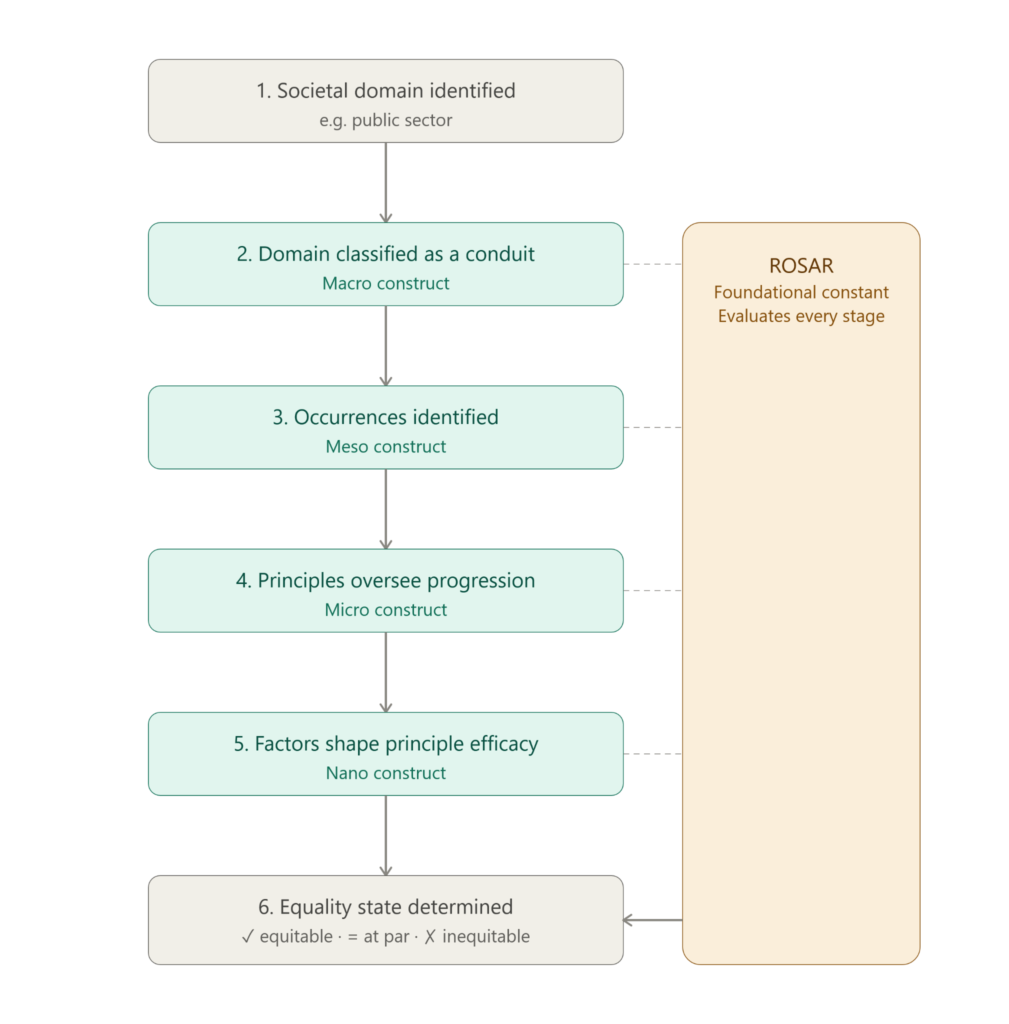
Examples 》
- ROSAR
- ┌─────────────────────────┐
- │ Foundational Constant │
- │ Present Throughout │
- │ Entire Process │
- └─────────────────────────┘
- │
- │
- │
- ┌───────────┐ │
- │ Conduit │◄──────┤
- │ Macro │ │
- └─────┬─────┘ │
- ▼ │
- ┌───────────┐ │
- │Occurrence │◄──────┤
- │ Meso │ │
- └─────┬─────┘ │
- ▼ │
- ┌───────────┐ │
- │Principle │◄──────┤
- │ Micro │ │
- └─────┬─────┘ │
- ▼ │
- ┌───────────┐ │
- │ Factors │◄──────┤
- │ Nano │ │
- └─────┬─────┘ │
- ▼ │
- ┌──────────────────┐ │
- │ Equality State │ ◄┘
- │ Determination │
- └──────────────────┘
Affirmations 》
Conduits function as the macro-level gateway between society and measurable equality. Proper conduit classification improves analytical precision and interoperability. Conduits support the scalability of the POE architecture.
Occurrences

Read More >>
Overview 》
Definition:
An occurrence is a manifested incident during the process of sow and reap.
Description:
A carrier Occurrences do not always represent the original source of an outcome but represent the observable point where the outcome becomes manifested. They are identifiable events, processes, or interactions in which one or more sowing actions produce corresponding outcomes. In addition, they provide the operational context required to examine how principles, factors, and variables influence progression.
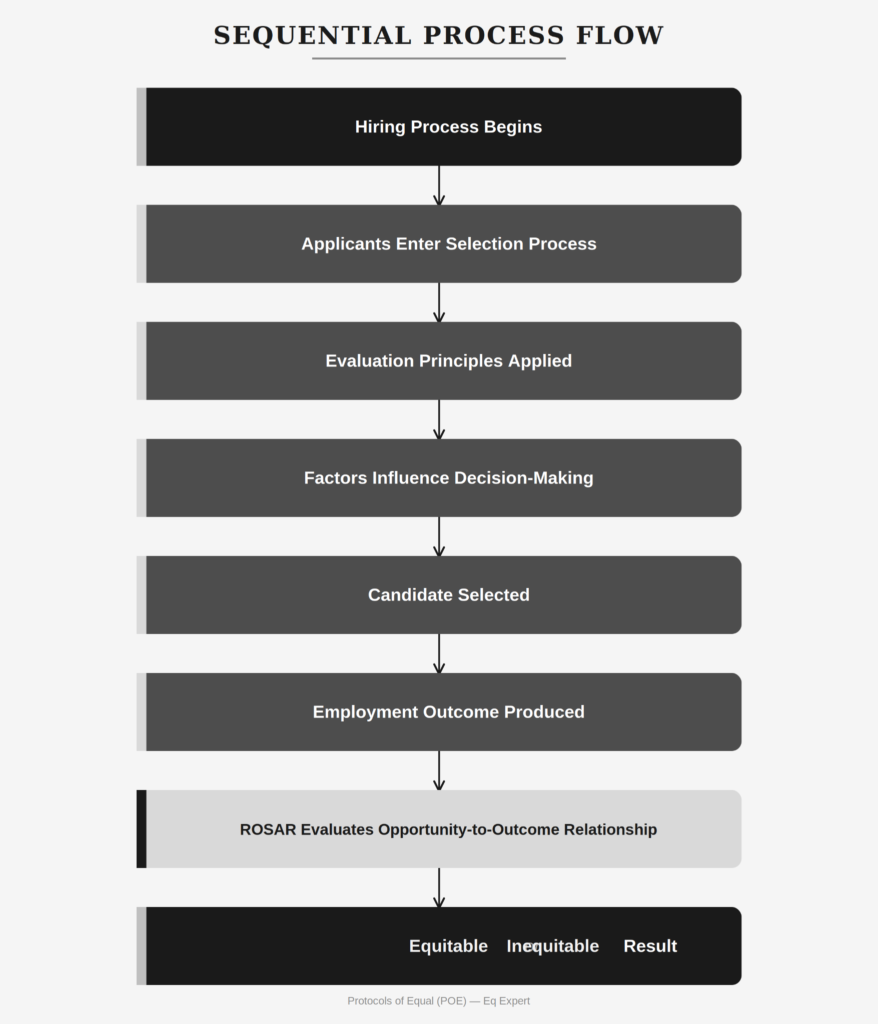
Examples of occurrences include adjudication, hiring decisions, policy implementation, resource allocation, and healthcare treatment.
Summary:
Occurrences are the meso level constructs that define the observable events where sowing and reaping take place. They represent the specific interactions, decisions, actions, or processes through which equality or inequality becomes measurable. Within the POE framework, occurrences provide the bridge between macro-level conduits and micro-level principles.
Occurrences provide the measurable unit of analysis for evaluating the progression of equality in relation to their corresponding conduits. They define the specific circumstances where Rule of Sow And Reap (ROSAR) can evaluate whether the relationship between sowing and reaping remains equitable or becomes inequitable.
Logical Premise 》
Society operates through countless interactions, decisions, and processes that produce consequences. Equality and inequality are experienced through these observable occurrences rather than existing only as abstract concepts.
Therefore, the POE identifies occurrences as the primary units through which sowing, reaping, and equality progression can be analyzed.
Axioms
- Every occurrence contains one or more sowing and reaping relationships.
- Every occurrence exists within at least one conduit or societal domain.
- Every occurrence is influenced by principles, factors, variables, and contextual conditions.
- Every occurrence produces measurable consequences that can be evaluated for equality progression.
Significance 》
Occurrences provide the measurable foundation for studying equality in real-world situations. They enable complex societal processes to be broken down into identifiable and analyzable events. By classifying occurrences consistently, the POE can compare, evaluate, and improve equality outcomes across different domains.
Puzzle Piece
Occurrences function as the meso level connection between societal conduits and operational equality analysis. Conduits establish the domain in which occurrences exist, while principles and factors influence how occurrences progress. The ROSAR evaluates the sowing and reaping relationship occurring within each occurrence.
Mechanics 》
How Does This Function?
- An occurrence begins when an action, decision, interaction, or condition creates a sowing event.
- The occurrence progresses through a series of relationships influenced by principles, factors, and variables.
- The resulting outcome is analyzed through ROSAR to determine whether the sowing and reaping relationship remained equitable.
| DATA POINTS (Core)(Only partially listed) | DESCRIPTION |
| Who? | Who is involved in this occurrence? |
| What? | What is involved in this occurrence? |
| When? | When is this occurrence? |
| Where? | Where is this occurrence? |
| How? | How is this occurring? |
| Why? | Why is this occurring? |
| DATA POINTS (Relational)(Only partially listed) | DESCRIPTION |
|---|---|
| Velocity | Measures how quickly an occurrence progresses from the initial sowing action to the resulting reaping outcome, such as how rapidly a discriminatory policy produces unequal effects. |
| Intensity | Measures the strength or severity of an occurrence’s impact, such as whether a decision produces a minor inconvenience or a significant restriction of opportunity. |
| Magnitude | Measures the overall size or scale of an occurrence, such as the number of people, resources, or systems affected by an unequal process. |
| Frequency | Measures how often an occurrence repeats, such as whether unequal outcomes occur once or become a recurring pattern. |
| Trajectory | Measures the overall pathway of an occurrence, such as whether current actions are improving, maintaining, or worsening the equality state. |
| Complexity | Measures the number of interconnected constructs, conduits, principles, and factors involved within an occurrence. |
| Status | Defines the current equality condition of an occurrence, such as equitable, at par, or inequitable. |
| Reach | Measures how far the effects of an occurrence extend beyond the original point of action. |
| Scope | Measures the boundaries of an occurrence, including whether its effects are limited locally or extend across organizations, regions, or different facets of society. |
| Duration | Measures the length of time an occurrence remains active, such as whether an inequitable practice exists temporarily or persists across generations. |
Base Components
- Occurrence Identifier — The unique classification of the event.
- Conduit Association — The societal domain where the occurrence exists.
- Sowing Elements — Actions, inputs, or decisions introduced into the occurrence.
- Principles — Rules or governing concepts influencing progression.
- Factors — Conditions influencing behavior and outcomes.
- Reaping Elements — Consequences produced by the occurrence.
- Equality State — The resulting classification.
Inputs (Sample)
- Actions
- Decisions
- Policies
- Resources
- Human behavior
- Environmental conditions
- Existing inequalities or advantages
Outputs (Sample)
- Observable outcomes
- Equality classification
- Inequality identification
- Corrective opportunities
- Data points for analysis
Examples 》
Public Sector Adjudication
- Conduit: Public Sector
- Occurrence: Legal Adjudication
- Principle: Upside of the Coin
- Factors: Power of Solutions Clause, Best A Human Can Do Clause
- Outcome: Equitable or Inequitable Judgment
Application (Sample Use Cases)
- Evaluating fairness within legal decisions.
- Measuring equality within hiring processes.
- Analyzing healthcare access outcomes.
- Reviewing policy implementation.
- Assessing resource distribution.
Affirmations 》
Occurrences provide the primary observable unit for equality analysis. Every occurrence represents a relationship between inputs, processes, and outcomes. The classification of occurrences enables consistent measurement across diverse societal domains. Through occurrences, abstract equality concepts become observable, measurable, and actionable. The ROSAR provides the governing framework for evaluating each occurrence.
Principles

Read More >>
Principles (Micro Constructs)
Overview 》
Definition:
Principles are foundational observed phenomena that can modify the process of sow and reap.
Description:
Principles are closely associated with the Rule of Sow And Reap (ROSAR).
This phenomena can and usually modifies conduits or occurrences.
Summary:
Principles direct the process of sow and reap. This could also affect the progression and relationships affiliated with it.They determine how actions, decisions, and interactions influence equality progression by shaping the behavior of occurrences and their participating constructs. Within the POE framework, principles provide the consistent rules that enable equality to be analyzed, measured, and evaluated across different societal domains.
Logical Premise 》
Occurrences of equality or inequality all have observable phenomena that affect the process of sow and reap. These phenomena are what’s called Principles. To achieve equality or solve inequality requires observations that are proximal to the process of sow and reap.
As society is ultimately defined by intent weighed by its corresponding outcomes, observing that what affects this process is vital. These observations must be properly labeled and organized to better understand the tendencies that lead to occurrences of equality or inequality. In addition, comprehension of the inner workings of these observable phenomena builds data that render quantifiable parameters. These are all necessary components that are mandatory to improve the progress of equality or address any inequalities. This is the primary purpose of a principle.
Principles solve all of these requirements. Thus making them a vital part of any effort towards equitability.
Axioms (Base Rules)
- Every occurrence is governed by one or more principles.
- The collective influence of principles contributes to the resulting equality state.
- Principles provide the oversight and logic for evaluating occurrences through the ROSAR.
- Changes in the application of principles may alter the direction of equality progression.
- Principles interact with factors and variables to influence equality in the process of sow and reap.
- Every principle contributes to the traceability and explainability of equality outcomes.
- Principles may promote either ascending (ASARC) or descending (DSARC) constructs.
Significance 》
Principles are what make the Protocols of Equal stand out from other frameworks
As part of the Map Of Sow And Reap Constructs (MOSARC), principles (micro components) explain how and why the conduits (macro components), and occurrences (meso components) manifest.
Principles are a set of rules that oversee the behaviors of certain phenomena that affect the process of sow and reap. They enable an intricate ability to comprehend, communicate, and modify the underlying factors that affect sow and reap.
Principles determine what methods must be used to arrive at an equitable outcome. The insight and comprehension of this micro yet foundational scope, uncovers the correlations of the observable phenomena, and their circumstances.
Principles enable an accurate lens that is close to the originating intent and factors that affected the process of so and reap. This is vital within every Instance of Sow And Reap (INOSAR). The accuracy of principles empower the formation of actionable Quantifiable Parameters utilized to detect, diagnose, index, reverse, and prevent inequalities. Optionally, actionable protocols can be formulated to improve the processes required to achieve an extremely high level of equality.
Mechanics 》
Principles are effective individually. However, when utilized together they possess a
substantial ability to map and track the underlying factors and variables that affect equality.
Facets of Principles:
Causes Effects
- Causes: Factors that produce the observed phenomena.
- Effects: The results of the observed phenomena.
Problems & Solutions
- Problems: Issues related to the observed phenomena.
- Solutions: Remedy for issues related to observed phenomena.
Applications & Limitations
- Application: Methods to apply the observed phenomena.
- Limitation: The constraints of the observed phenomena.
This data value set is the frame, and scope to analyze how principles interact with the process of sow and reap, and contribute to occurrences of sow and reap. Thus making it much easier to determine if a particular occurrence is equitable, at par, or inequitable.
Each principle is consisted of the following:
- A Parent Principle or “Super Principle”. This is the actual observed phenomena that spans both the ASARC (equality) & DSARC (inequality) processes of sow and reap.
- An ASARC Principle. This phenomena operates solely as part of the equality constructs. It assists the progression towards the Apex of Equality.
- A DSARC Principle. This phenomena operates solely as part of the inequality constructs. It assists the progression towards the Apex of Inequality.
- Factors (Nano Components)
- All principles have at least one ASARC Clause. Its designated purpose is to upkeep the process of sow and reap within this specific ASARC principle. As such it defends the progression towards the Apex of Equality.
- All principles have at least one DSARC Deviate. Its designated purpose is to upkeep the process of sow and reap within this specific DSARC principle. As such it defends the progression towards the Apex of Inequality.
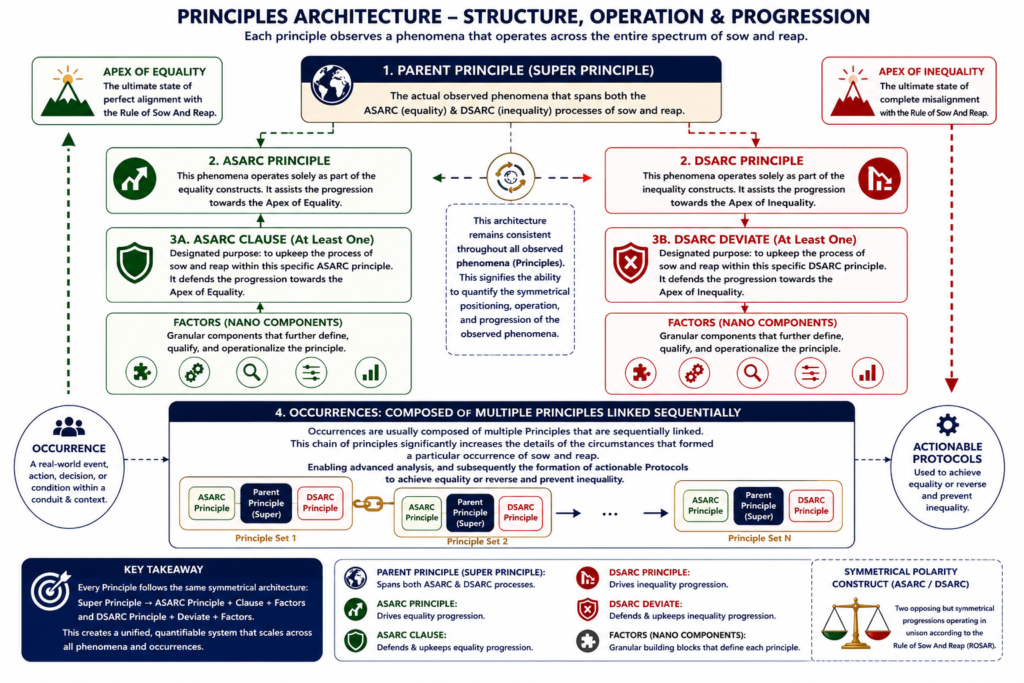
This architecture remains consistent throughout the observed phenomena (Principles). This signifies the ability to quantify the symmetrical positioning, operation, and progression of the observed phenomena.
Occurrences are usually composed of multiple Principles that are sequentially linked. This chain of principles significantly increases the details of the circumstances that formed a particular occurrence of sow and reap. Enabling advanced analysis, and subsequently the formation of actionable Protocols to achieve equality or reverse and prevent inequality.
Examples 》
Timing of sow and reap (Parent / Super Principle)
- Prudence Of Sow And Reap – ASARC Principle
- Equate Natural Timing – ASARC Clause: This clause defends the Prudence of Sow And Reap principle
- Latency Of Sow And Reap (LOSAR) – DSARC Principle
- Sabotage Natural Timing – DSARC Deviate : This deviate defends the Latency Of Sow And Reap
The above example demonstrates the Symmetry Polarity Construct; Whereby, both Principles and factors operate in unison according to the ASARC / DSARC progression. Thus maintaining a logically unified and quantifiable architecture.
Affirmations 》
Read some of the principles to better understand how intricate they are individually. Then, assess how much more effective they are when cross referenced and paired with other correlated principles to form sequences that lead to occurrences or conduits related to equality or inequality.
Sample Principles >>
Abetting Via Ignorance
Definition: Ignoring solutions that could assist targets of inequality.
Description: Ignorance could be social, professional, or formal. Those who abet inequalities via professional or formal ignorance are usually held accountable. Social ignorance is frequently the precursor to untraceable inequities or even lethal circumstances.
ADJUSTED VALUATION OF SOW AND REAP (AVOSAR)
Definition: The reconciliation and calibration of the initial valuation of sow and reap with the affected valuation of sow and reap to arrive at an adjusted valuation of sow and reap.
Description: When the affected process of sow and reap is negatively affected, a calibration is required. This is accomplished by factoring the differences of the original valuation of sow and reap with the affected valuation of sow and reap. The difference is now considered the cost (value of hardships) incurred by the negation of sow and reap.
APPROVAL FROM THE BAD (AFTB)
Definition: The reluctance to make choices or perform actions without the approval of individuals or groups whom operate in ways that morals can be, and is usually undermined.
Description: ‘The Bad’ are individuals or groups whom operate in ways that morals can be, and is usually undermined. These ‘Bad’ entities can be outwardly known, however often times they operate from obscure vantage points of control, in the ‘shadows’. This make is difficult to trace them or their level of influence, or even validate their existence.
ARMS HYPOCRISY
Definition: Is there such a thing as a hypocrite at arms?
Description: Without the potential for reciprocal treatment, the moral integrity of arms enforcement is likely compromised. Especially if arms are applied without invoking the Power Of Solution clause. It’s unjust for the enforcer to persecute a person for circumstances that can not be reasonably prevented by either the enforcer nor the person(s) involved.
ASSEMBLE VIA INTENT AT CROWN (AVIAC)
Definition: To assemble via declared intent at the Crown of the country.
Description: To assemble or group people according to their proven personal intent. The Seed Clause must be applied to validate personal intent. The AVIAC clause is for those who deem it necessary to be properly represented at Crown.
COERCION OF INFERIOR INTENT
Definition: Coercion to accept inferior intent.
Description: Forced acceptance of lessor intent. The access and control of valuables and their environments are used to suppress the defense of superior intent. Especially when beyond the direct control of the subjects.
Equal Is Safety
Definition: Anything less than equal leads to conflict. It’s a matter of who, what, when, where, and how?
Description: Equality and safety have a strong correlation. When people do not get their equal share, there is likely resentment, and oftentimes disagreements. This could lead to violence.
EQUATE AWARENESS
Definition: To ensure all individuals are aware of mandatory conduct and the peripherals that may affect them.
Description: It’s a human right to be made aware of the rules and inner workings that oversee one’s daily experience, whether formal or informal. All must have the same level of awareness for basic necessitates and what is required to access them. Especially if they affect human rights.
Evil Action Good Reaction Discrepancy (EAGRD)
Definition: Evil actions cannot be defeated by similar actions even when carried out with opposing good intent.
Description: Evil intent and actions usually transpire in with an element of surprise, typically in secrecy. Therefore, they mostly precede ‘good reactions’. The latency of response is critical and could be lethal.
FALSE UTILITARIANISM
Definition: The application of utilitarianism without the Omnipresence Of Sow And Reap.
Description: Every person must have an equated basis to equally sow and reap for utilitarianism to be truly valid. Otherwise, its moral benefits become negated as the basis of what is good, and who the many are, is skewed. The concept of ‘Greater good’ does not guarantee the higher, more refined principle of ‘Equal share’.
Hedging Ignorance
Definition: Intentionally influencing the ignorance of inequalities to compound the results of an intended outcome.
Description: When unequal parties exert immoral influence to control people. This could be direct or indirect. The control of social vices is one of the strategies used to immorally control people into belief systems that lack equal foundations.
Hindrance Of Sow And Reap (HOSAR)
Definition: Any unnecessary hindrance to the naturally occurring process of moral sowing and reaping.
Description: Hindrances of Sow And Reap can arrive in many forms. Such as immoral treatment from an unequal arms house, rigid policies that prevent equality within a large organization, or even unjustified prolonged red tape within a formal system. The affects hindrances have upon a particular process of Sow And Reap can be detrimental to the affected parties.
Human Threshold (Hum Thresh)
Definition: The point of intersection where human livelihood is either sustained or negated.
Description: Without physical conflict it’s not easy to negate the human threshold. However, there is a certain number ratio where this becomes likely. The average human has a relatively similar amount of personal strength (mental or physical), plus or minus a given percentage.
IGNORANCE UNTIL AFFECTED (IUA)
Definition: To solve problems according to their place of origin, whether internal or external.
Description: The use of internal solutions to solve internal causes as opposed to external efforts. Oftentimes external efforts are based on the external effects of what was originally due to an internal cause. For this example, we will refer to external efforts as ‘outflux’.
INEQUALITY AMPLIFIER
Definition: Mechanisms or systems that take existing small inequalities and magnify them into larger disparities.
Description: Compound interest effects in resource allocation, network effects that favor the already advantaged
Internal External
Definition: Equilibrium of internal and external intent.
Description: Hearts and souls are the true indicator of internal intent. The external strength of a group is dependent upon its individual internal core values. The personal belief of each member within a particular organization must be in exact unison with its root philosophy.
Latency Of Sow And Reap (LOSAR)
Definition: When the results of sow and reap is delayed to a point of significantly less or no benefits.
Description: Depending on the extent of latency, the eventual harvest could be received by the original benefactor or a new benefactor such as an heir apparent, or an individual or group that shares a core commonality. The original victims of delayed sow and reap usually receive little or no compensation, for the inequities faced during the period of latency. At times only receiving an acknowledgment of the inequalities that transpired by decision makers.
LEVEL OF REQUIRED APTITUDES (LORA)
Definition: The calculation and importance of natural aptitudes required for particular tasks or positions.
Description: Proven Natural Aptitudes (PNAPs). Aptitude Interference Factors (AIFs) – Justification of discrepancy (Can the discrepancy be tolerated without much difference in performance? Can the discrepancy be rectified in a reasonable time frame?
LEVERAGING THE HAMMER (LVT)
Definition: Leveraging the total arms resources of a people or jurisdiction on a specific individual or relative few.
Description: Leveraging The Hammer occurs within formal and informal arms. It is a lethal effect of inequality. Especially if applied without moral reasoning or adequate declaration.
Omnipresence of Sow And Reap (OOSAR)
Definition: The constant presence and excessive availability of methods to equally sow and reap.
Description: The Omnipresence Of Sow And Reap is a requisite in the pursuit of an equated basis. To thoroughly implement and articulate the Rule Of Sow And Reap within a group or people such as a local community, regional area, country, or even a multinational alliance. This safeguard should be applied in all vital areas of society such as health, money, and arms.
Personal Autonomy
Definition: Right to sentience and sovereignty as an individual along with personal choice & space.
Description: A sentient individual has a right to maintain personal internal autonomy. Any external control must have a strong moral basis, and be properly vetted by proven moral methods. Freedom from unwanted psychological or metaphysical attempts to undermine or control the human anatomy via direct, indirect, or any subversive methods.
Principle of Equal Consideration
Definition: The Principle of Equal Consideration dictates that the interests of every individual affected by an action or decision must be given the same weight, without discrimination based on arbitrary characteristics such as race, gender, religion, or species. It is the foundational bedrock of fairness.
Description: This does not mean treating everyone identically, but rather that similar interests should be treated similarly. The pain of one being is not more or less important than the equivalent pain of another.
REQUISITE OF THE HAMMER (ROTH)
Definition: The requisite of force to achieve compliance, even when face with a moral request.
Description: At its fundamental basis, equality is natural. However, Requisite Of The Hammer infringes upon a natural order of human choices. It makes naturally occurring experiences unnaturally influenced.
Right of Sow And Reap (RIOSAR)
Definition: The entitlement to equally sow and reap for acquisition of sustenance and possessions.
Description: The Right of Sow And Reap is a basic human right. It’s a derivative of the naturally occurring and universal, Rule of Sow And Reap. Every person has a right to organically source their sustenance via the Right Of Sow And Reap.
RULE OF SOW AND REAP (ROSAR)
Definition: A universal constant that validates equality via the equilibrium of sow and reap; or cause and effects; efforts and results; or input and output.
Description: The Rule Of Sow And Reap can be applied to man-made society in several ways such as cause and effect, efforts & results, and input and output. The Rule Of Sow And Reap is the first organic step towards acquisition of existence. It commences one’s ability to secure sustenance, especially within a societal context.
Social Control Mechanisms (SCMs)
Definition: Methods used to control social behavior through informal pressure rather than formal rules.
Description: A valuable item or experience such as money, status, arms, and sex. Things that we all deem as important to our societal livelihood as they can affect our personal choices and experiences. Including yet not limited to, love and relationships, including sex; money and financial connections; and personal or professional groups or networks.
Status Quo Enforcer
Definition: An entity that enforces what actions are permissible in networks.
Description: A Status Quo Enforcer may be an individual or a group. It could be an unofficial, implied position that is occupied via forceful or non-forceful methods. Their primary objective is to control the access and flow of valuables such as items, experiences, or status.
Superior Inferior (Super Infer)
Definition: Moral intent and actions exemplify an aesthetic superiority that is desired and often leeched upon by those of opposing inferior intent and actions.
Description: Superior intent, actions, and possessions routinely face attacks from inferior intent and actions. The desire to reside under the roof of moral rooted individuals and assemblies is high. However, unequal people refuse to apply the morals and discipline required to achieve a genuine aesthetically pleasing attire.
SYSTEMATICAL TERRORISM
Definition: The use of organized systems to exert immoral or hypocritical control via arms.
Description: Systematical Terrorism is oppression. If left unchecked it could grow into tyranny. Although this can occur intentionally, it often occurs unintentionally due to inefficient rules, conduct, and negligence.
TRANSFERENCE OF INTENT
Definition: The flow of immoral intent and actions to a moral roof.
Description: Transference of Intent occurs to undermine the existing moral intent. It can occur as an individual or collective. Once it occurs at a micro level, if left unchecked, it usually occurs at a macro level; and vice versa.
UNSOWN REAPINGS
Definition: Benefiting from or claiming credit for work, achievements, or contributions made by others.
Description: Credit appropriation, unacknowledged contributions, benefit extraction without contribution
Upside of The Coin (Up The Coin)
Definition: Unconcern of inequalities or their causes due to wielding an influential hierarchical advantage.
Description: This hierarchical advantage is usually circumstantially applied to those of an initially similar grouping of allowances or capabilities. The fate of the coin is experienced by all. However, the upside of the coin is always in control of the entire coin.
Factors (Nano Constructs)

Read More >>
Overview 》
Definition:
Factors operate between principles and the foundational constant, Rule of Sow And Reap (ROSAR). This is why they are the Nano Components of the MOSARC.
Description:
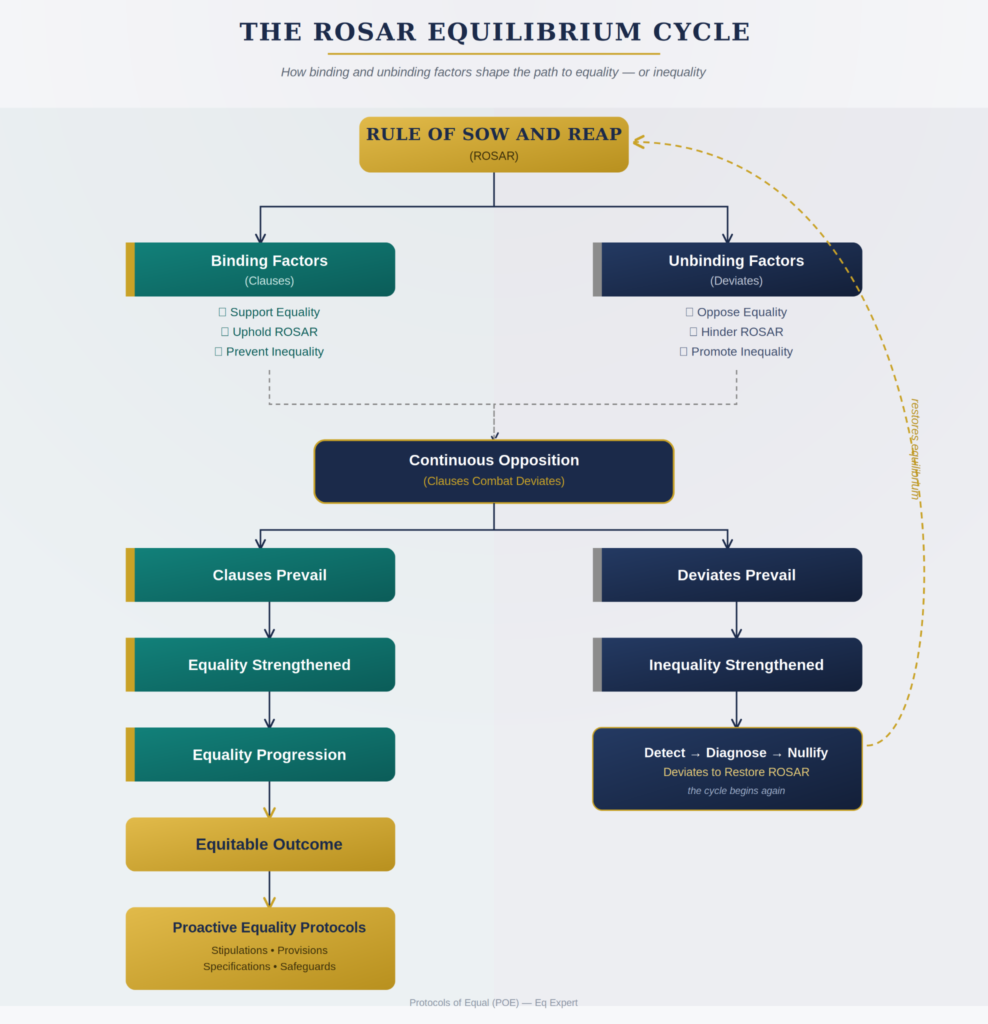
Binding Factors (Clauses) support equality and oppose inequality. Thus, they are positive.
Unbinding Factors (Deviates) oppose equality and support inequality. Thus, they are negative.
Summary:
Clauses are binding factors (The Heros) that strengthen and upkeep the process of sow and reap. Their objective is to advance or maintain existing equalities.
Deviates are unbinding factors (The Villians) that weaken and hinder the process of sow and reap. Their objective is to spread or maintain existing inequalities.
Neutralizers are neutral factors (The neutralizers) that can bind or deviate the ROSAR depending on its application.
Factors substantially assist to reveal what happens at the most fundamental level during the process of sow and reap.
*Ascending Sow And Reap Constructs (ASARCs) are progressions that aspire towards the Rule of Sow And Reap (ROSAR). Descending Sow And Reap Constructs (DSARCs) are regressions that deviate from the Rule of Sow And Reap (ROSAR).
Logical Premise 》
Principles are the observed phenomena that occur during the process of sow and reap. However, Factors are intricate components that influence Principles and determine the outcome of the phenomena. This affects the entire process of sow and reap including Occurrences, and Conduits. Thus, it is necessary to map and further observe the factors that influence how principles affect the process of sow and reap.
In addition, understanding the mechanisms and operation of principles is essential to reveal deep insights about their inner workings during a particular process of sow and reap.
Axioms (Base Rules)
Influence: Every occurrence is influenced by one or more factors that modify the progression of sow and reap.
Classification: Every factor shall be classified as a Binding Factor (Clause), Unbinding Factor (Deviate), or Neutral Factor (Neutralizer) according to its influence on the Rule of Sow And Reap (ROSAR).
Binding: Binding Factors (Clauses) strengthen, preserve, or restore alignment with the Rule of Sow And Reap (ROSAR). Thereby, supporting equality progression.
Unbinding: Unbinding Factors (Deviates) weaken, distort, interrupt, or redirect alignment with the Rule of Sow And Reap (ROSAR). Thereby, contributing to inequality progression.
Neutrality: Neutral Factors (Neutralizers) possess no fixed polarity and may function as either binding or unbinding influences depending upon their application and context.
Interaction: Multiple Factors may simultaneously interact with one another to collectively influence the behavior of principles, occurrences, and resulting outcomes.
Traceability: Every measurable change in equality progression shall be traceable to one or more contributing Factors.
Scalability: Factors operate consistently across all levels of the POE framework, from individual interactions to complex societal systems.
Significance 》
Factors make it possible to understand the process of sow and reap at its most fundamental level. They literally only exist to bind, or latch on to the Universal Constant. Therefore directly supporting or negating a particular Principle.
Additionally, Factors provide valuable granular information about principles and their inner workings. While Principles are the observed phenomena, factors are what binds or unbinds a phenomena to a particular progression during the process of sow and reap. Progressions could be ASARC (Equality) or DSARC (Inequality).
Subsequently, providing an additional dataset of the things that directly bind or unbind the Rule of Sow And Reap (ROSAR).
Clauses defend ASARCs and weaken the influence or presence of DSARCs. Thus, clauses are the “Heros”.
Deviates defend DSARCs and attempt the influence or presence of ASARCs. Thus, deviates are the “Villians”.
Mechanics 》
Factors tend to exhibit a non randomized behaviour. They are usually intent driven. As a result can affect principles and the outcome of the process of sow and reap. This is the intricate role they play within the Map Of Sow And Reap Constructs (MOSARC).
Factors
│
├── Clauses (Binding Factors)
├── Deviates (Unbinding Factors)
└── Neutralizers (Conditional Factors)
Binding Factors (Clauses)
- Champions and upkeep the progress towards the apex of equality.
- Always explicitly supporting equality thus, negating inequality.
- They combat deviates and consequently prevents non binding factors from hindering the Rule of Sow And Reap (ROSAR).
- Produce proactive Actionable Protocols (stipulations, provisions, specifications etc)
Unbinding Factors (Deviates)
- Components of principles that hinders or facilitates the hindrance of the Rule of Sow And Reap (ROSAR).
- Always explicitly negating equality, thus supporting inequality.
- Potentially, a reliable method to detect & diagnose inequality.
- Reversing and preventing inequality requires nullifying the deviate(s) involved.
Examples 》
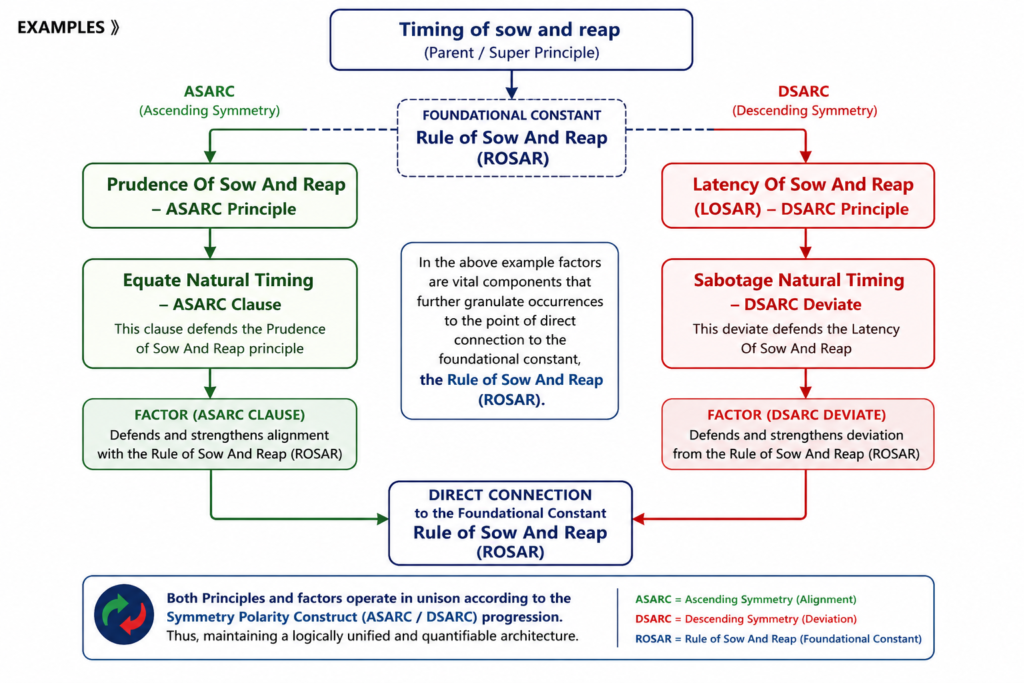
Timing of sow and reap (Parent / Super Principle)
- Prudence Of Sow And Reap – ASARC Principle
- Equate Natural Timing – ASARC Clause: This clause defends the Prudence of Sow And Reap principle
- Latency Of Sow And Reap (LOSAR) – DSARC Principle
- Sabotage Natural Timing – DSARC Deviate : This deviate defends the Latency Of Sow And Reap
In the above example factors are vital components that further granulate occurrences to the point of direct connection to the foundational constant, the Rule of Sow And Reap (ROSAR).
Both Principles and factors operate in unison according to the Symmetry Polarity Construct (ASARC / DSARC) progression. Thus, maintaining a logically unified and quantifiable architecture.
Affirmations 》
Factors tend to exhibit a non randomized behavior. They are usually intent driven. That’s why they play an intricate role within the Map Of Sow And Reap Constructs (MOSARC)
Factors provide valuable granular information about principles and their inner workings in regards to a particular process of sow and reap. Additionally, they substantially assist to reveal what happens at the most fundamental level during the process of sow and reap.
Sample Clauses >>
ACCREDITED ACCOUNTABILITY (AA)
Definition: System of verified responsibility that credits actions to their true originators and holds them accountable
Description: Corporate transparency in decision-making, political accountability for policy outcomes
Best A Human Can Do (BAHCD)
Definition: Performing tasks, activities, or traversing situations as best as humanly possible with the resources and knowledge reasonably available.
Description: Human performance must always be considered when adjudicating equality. BAHCD is a mandatory factor in securing the moral integrity of adjudication. The entirety of the situation must be assessed with all variables that could affect human performance accounted for.
Clause of Procedural Fairness
Definition: This clause mandates that all processes used to make decisions affecting individuals must be transparent, unbiased, and provide an opportunity for all affected parties to be heard.
Description: It ensures that the ‘how’ of a decision is as just as the ‘what’. Even a correct outcome can be unjust if arrived at through a flawed process.
Demarcator
Definition: An individual, group or any affected entity of an unequal occurrence, that serves as a reference
Description: The primary victim affected by a particular occurrence of inequity. The affected party of any unequal occurrence must be the central focus of any efforts to equate inequities. This occurrence must have a certain level of significance.
DUE DILIGENCE CLAUSE
Definition: Requires individuals and organizations to actively seek out and understand potential inequalities before taking action.
Description: To promote proactive prevention by making ignorance of potential harm an unacceptable excuse.
INEQUALITY PREVENTION UNIT (IPU)
Definition: Dedicated organizational units specifically focused on identifying and preventing inequality before it occurs.
Description: Corporate equity offices, institutional bias prevention teams, community fairness committees
INTERNAL INGENUITY (I.E)
Definition: Developing innovative internal solutions using existing resources and capabilities within organizations or systems.
Description: Employee-driven innovation programs, internal mentorship systems, resource reallocation strategies
NEUTRALITY CLAUSE
Definition: To maintain an equated stance for all sides of a specific circumstance.
Description: The only neutral stance for a third party is to equally apply the Rule Of Sow And Reap, to all parties involved within a particular situation. Neutrality requires the equilibrium of an unbiased, pro equal approach towards all parties involved. A truly equated approach.
POWER OF SOLUTIONS CLAUSE (POSC)
Definition: The requisite to provide an equitable solution before infringing upon basic human rights.
Description: This requisite includes, yet not limited to, freedom of speech, movement, and rights of property. A mandatory defense against the Arms Hypocrisy Principle. The Root Cause Clause must be applied to ensure accuracy of solution.
PREVENTION OVER CURE (POC)
Definition: This clause prioritizes proactive measures to prevent inequality over reactive measures to fix it after it has occurred. It mandates a forward-thinking approach to system and policy design.
Description: To create resilient, equitable systems that anticipate and mitigate potential inequalities, reducing the need for costly and often incomplete ‘cures’.
ROOT CAUSE
Definition: The accurate assessment of the initial reason that led to the breaking of the Rule Of Sow And Reap.
Description: Every root is formed from a seed. Once the root is formed, there are often fertilizing actions. The Root Cause must be accounted for before adjudication, and enforcement, especially when arms are involved.
Seed Clause
Definition: The validation of personal intent at a root level.
Description: The seed always indicates root intent. The Rule Of Sow And Reap (ROSAR) is a universal rule. Its fundamental to protecting human rights.
THE RIGHT OF EQUAL ENFORCEMENT
Definition: The basic human right of accurate enforcement of equality.
Description: This accurate enforcement of equality is a mandatory survival right. It’s a safeguard against inequalities and can be formal or informal. The Right Of Sow And Reap makes it clear that all individuals have a right to equally sow and reap.
SEQUENCES

Read More >>
The integral formation of multiple interrelated principles that contribute to the manifestation of a construct of sow and reap. This includes conduits, occurrences, apex, revelation, and reversal. Sequences are ‘the chains’ while principles are the links on those chains. They reveal much data about the reasons why a particular circumstance of sow and reap has manifested. Sequences provide detailed intricate information surrounding the manifestation of a sow and reap circumstance.
At the Protocols of Equal institute we have observed the majority of equality related matters have an associated sequence. Usually, this includes a succession of multiple principles (observed phenomena). This demonstrates circumstances relating to equality are usually the result of a process, as opposed to a singular event; frequently assessed as random. Sequences are the “Chains” of this process, while Principles are the “Links” on the chains. Often times there are multiple sequences involved in an equality related circumstance. For instance, there could be a Sequence for occurrences, and one for conduits. Correspondingly, there would correlated Sequences for experiences, reversals and prevention.
ARCHITECTURE

Read More >>
The advanced architecture of Protocols of Equal enables it to account for all matters relating to equality via one coherent structure. The core components of the POE can be substituted by variables. For example, variable placeholders can be used for conduits of equality, and their occurrences. Empowering the POE to account for and quantify nearly every conduit, or occurrence that could ever be associated with equality or inequality, with the same formula.
Exchange Constructs
The ability to exchange the constructs of equality with variables provides a mathematical, and potentially empirical basis. Making it possible to form complex data driven models required for advanced mathematical computations. A benefit that will yield thorough statistics. As a result, equipping the Protocols Of Equal to extract vital foundational information from the same logically unified and mathematically consistent framework.
Gather Relevant Data
Increasing the capability to gather and compare equality related data from the same foundational framework, enhances comprehension, and subsequently proficiency of application. Thus, transforming equality from overarching nostalgic pursuits into quantifiable constructs of equality. Accordingly, giving rise to actionable protocols that can detect, diagnose, reverse and prevent inequalities. This dynamic architecture makes the Protocols Of Equal a truly powerful and comprehensive equality framework.
QUANTIFIABLE PARAMETERS & METRICS

Read More >>
The Map Of Equality Constructs (MOEC) provides parameters for the underlying factors and variables that affect equality. These parameters make equality quantifiable. This enables the extraction of relevant metrics that pertains to the interactions of equality constructs, their underlying factors, and associated variables. Complex equality driven data models are now possible.
Ideally, this will provide detailed statistics that will eventually yield measurable equality outcomes. For example, a reliable system that accurately measures equality we call, the “Equality Quotient”. Quantifiable parameters and metrics provided by the Protocols Of Equal will produce methods that are of high value within the emerging landscape of a society driven by equality and human rights.
ACTIONABLE PROTOCOLS

Read More >>
As the MOEC transforms equality from overarching nostalgic pursuits into constructs of equality that can be audited and enforced.. Each construct has underlying factors and variables. Comprehension of how these constructs interact enables the formation of actionable protocols. Ones that can navigate the intricacies of the underlying factors and variables that affect equality.
The result is a newly created ability to ‘map, pinpoint, and track’ the causes and effects of the underlying factors and variables that affect equality at revealing depths. As a result, yielding new methods to approach equality within society. This includes the ability to detect, reverse and prevent previously untraceable inequities. The goal is to utilize these actionable protocols to significantly reduce inequalities, and achieve Extremely High Level Equality (EHLEQ).
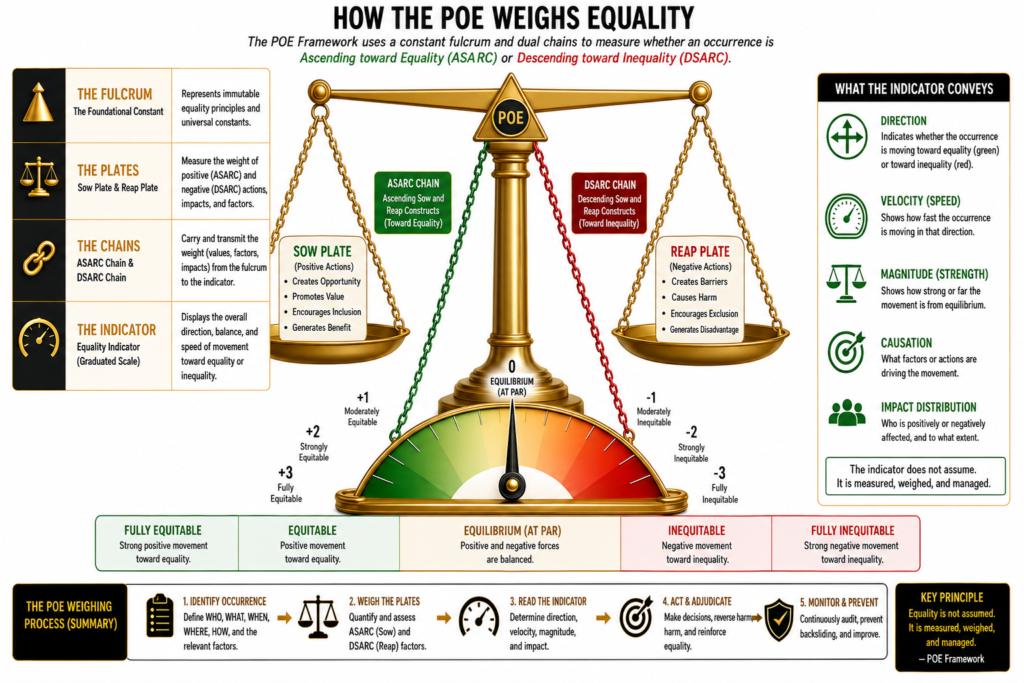
POE Scale
Read More >>
The gauge of equality.
Logical Premise
The prefix ‘equ’ and ‘equi’ are rooted in concepts associated with balancing, weighing, leveling, and achieving equilibrium. Equality, equity, equilibrium, equivalence, and equanimity all originate from the same fundamental notion that multiple conditions must be evaluated in relation to one another. Hence, all these “Equ” concepts and their derivatives inherently exhibit a certain innate symmetry.
Architecture: The Protocols of Equal extends this principle into a complete equality architecture. Rather than treating equality as an abstract aspiration, the POE framework is structured around the concept that equality requires the balanced observation, interpretation, and evaluation of multiple conditions.
Computation: This foundational commitment to symmetry is significant because equality itself cannot be meaningfully evaluated through asymmetrical analysis. The POE therefore embeds symmetry throughout its architecture, enabling consistent equality interpretation, computation, classification, and governance.
The Logical Premise stated above is an Excerpt from “What makes the POE Unique?: The Architectural Foundations of Universal Equality Infrastructure – ‘Equ’”
Symmetrical Polarity Construct
The Symmetrical Polarity Construct (Component of the MOSARC), streamlines the process of measuring the process of sow and reap. It enables the provision of values for each construct component. This means the scale is fully symmetrical and compute-able.
Analytical Value
Symmetry: The Symmetry of the POE enables a consistent analysis that can be validated and observed:
Granular Data Coverage: The multiple levels of the POE architecture ensure all levels of ‘Eq’ are properly identified.
The above features provide the POE with strong analytical capabilities.
Enabler
Within the POE, equality and inequality are represented as direct polar opposites, with mirrored symmetrical components. This is what enables the POE Scale to weigh any process of sow and reap with an extremely granular gauge. The results of the POE Scale span from extreme, to partial, to none. Refer to the Scaling Table diagram below.
| Equality | Inequality | |
| Extreme Equality | ↔ | No Inequality |
| Partial Equality | ↔ | Partial Inequality |
| No Equality | ↔ | Extreme Inequality |
Scaling table diagram
The Scale functions as follows:
| Score | Meaning |
| +5 | Fully equitable system (90% equitable) |
| +4 | Significantly equitable system (minor inequities) – (80-90% equitable) |
| +3 | Mostly equitable system (noticeable inequities) – (70-80% equitable) |
| +2 | Moderately inequitable system (moderate inequities) (60-70% equitable) |
| +1 | Barely equitable system (considerable inequities) (55-60% equitable) |
| 0 | Neutral / parity (+/-5 equitable) |
| −1 | Barely inequitable system (considerable equities) (55-60% inequitable) |
| −2 | Moderately inequitable system (moderate equities) (60-70% inequitable) |
| −3 | Mostly inequitable system (noticeable equities) (07-80% inequitable) |
| −4 | Severely inequitable system (minor equities) (80-90% inequitable) |
| −5 | Fully inequitable system (90% inequitable) |
This makes it possible to determine the “Equality Quotient” (Final score of equality).
POE Calculator

Read More >>
“Equality can be quantified!”
Purpose
The POE Calculator enables a foundation for reliable equality calculations. It’s a computational module designed to translate observed sow and reap relationships into measurable equality values. It provides a consistent mathematical foundation for evaluating, comparing, aggregating, and auditing equality states across individual and collective systems.
The Eq Scale: Eq+, or Eq =, or Eq –
Every Eq Scale is:
- symmetrical
- finite
- discrete
- configurable
Every Eq Scale is symmetrical around Eq 0. The level of intricacy is reflected according to the depth of the scale. Ie. 3,5,7,9.
Whereby:
- An Eq + denotes an equitable score.
- An Eq 0 denotes an at par / neutral score.
- An Eq – denotes an inequitable score.
The maximum positive value always has an equivalent negative value (e.g., Eq +5 / Eq −5), allowing proportional comparison regardless of scale depth.
Sample Weighing
5 Point Scale (Mostly Equitable)
Eq+ (4) / Eq 0 / Eq –
5 Point Scale (Mostly Inequitable)
Eq+ / Eq 0 / Eq – (4)
Weighed Value → Numerical value
Weighted values normalize constructs with different levels of importance, ensuring that higher-impact constructs proportionally contribute more to the final Equality Quotient.
Observed Value → Weight Applied → Weighted Value → Numerical Conversion
Numerical Values
Weighted values are converted into numerical values. They can later be utilized for computations. Numerical values can be placed on each individually identifiable construct (Factors, Principles, Occurrences). The individual scores can then be amalgamated to produce an aggregate score.
Partial Numerical Value
This numerical value is computed locally within the framework to render an Eq score for constructs (Occurences, Principles, Factors etc.)
Complete Numerical Value
These numerical values can now be computed globally within the POE (All constructs) to render a final eq score, for this particular Instance of Sow And Reap (INOSAR). Ie Individual INOSAR Numerical Score.
Aggregate INOSAR Numerical Score
The individual scores of each Instance of Sow And Reap (INOSARs) can now be amalgamated to produce an aggregate score of all correlated INOSARs. Aggregate INOSAR scores enable equality assessment at progressively larger scales, including teams, organizations, communities, municipalities, provinces, nations, and international systems.
The POE calls this score the Equality Quotient.
Assertions
The above formula suggests the POE is capable of gathering large data sets of relevant traceable information relating to the process of sow and reap.
Computational Capability
The POE Calculator enables the broad spectrum of equality-related occurrences to be systematically indexed, categorized, measured, and evaluated through a unified computational architecture. By connecting observed sow and reap relationships to structured measurements, the framework creates traceable equality intelligence across diverse domains.
Auditability and Verification
More importantly, it can be audited and verified as accurate. Any discrepancies can be traced, appropriately adjusted, and enforced accordingly. Essentially, the logically unified architecture of the Protocols of Equal produces logically unified mathematics. This combination of ethical, logical, and structural axioms, backed by mathematical axioms creates a foundation for potentially reliable calculations.
Update-ability and Extensibility
As a final note, the POE Calculator module is highly updateable, and extensible. Thus, fine tuning its design is entirely possible as the POE scales to meet its original vision.
Workflow
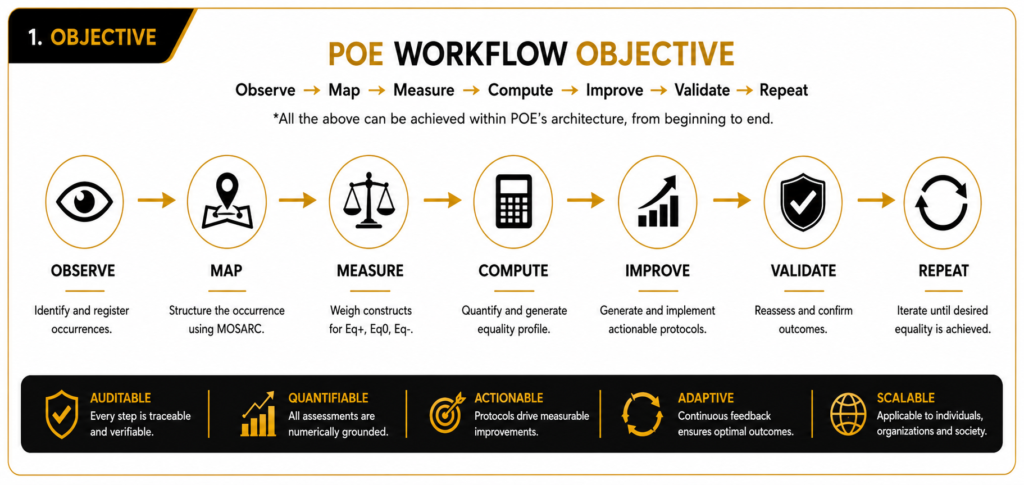
Read More >>
Overview of how the POE’s closed-loop operational system operates.
Objective
Observe → Map → Measure → Compute → Improve → Validate → Repeat
*All the above can be achieved within POE’s architecture, from beginning to end.
Sequence
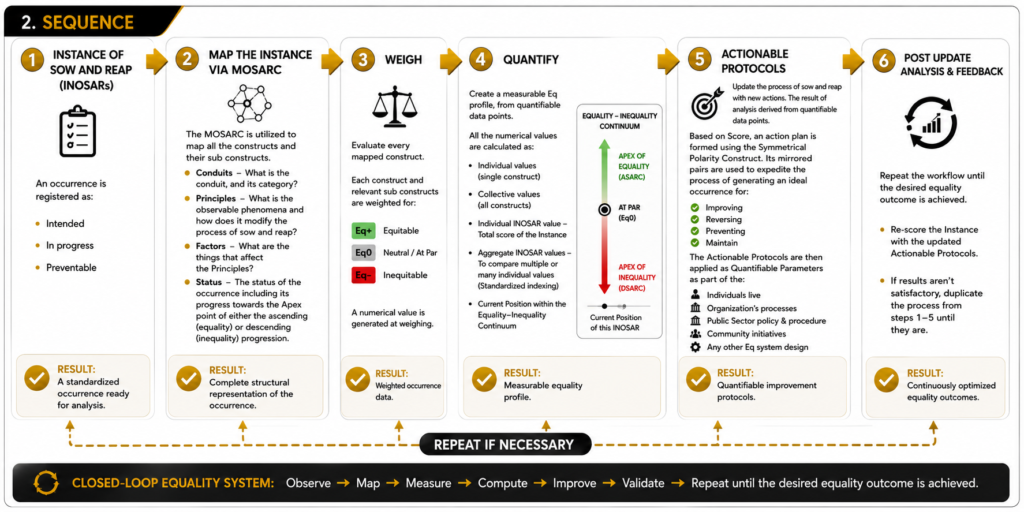
- Instance of Sow And Reap (INOSARs)
- An occurrence is registered as
- Intended
- In progress
- Preventable
- An occurrence is registered as
*Result: A standardized occurrence ready for analysis
- Map the Instance via MOSARC
*Complete structural representation of the occurrence*
- The MOSARC is utilized to map all the constructs and their sub constructs
- Conduits – What is the conduit, and its category?
- Principles – What is the observable phenomena and how does it modify the process of sow and reap?
- Factors – What are the things that affect the Principles?
- The status of the occurrence including its progress towards the Apex point of either the ascending (equality) or descending (inequality) progression.
*Result: Complete structural representation of the occurrence.
- Weigh
*Evaluate every mapped construct*
- Once mapped, each construct and relevant sub constructs are weight for Eq+ (equitable), Eq- (inequitable), or Eq 0 (neutral / at par)
- A numerical value is generated at weighing
*Result: Weighted occurrence data.
- Quantify
*Create a measurable Eq profile, from quantifiable data points*
- All the numerical values are calculated as:
- Individual values (single construct)
- Collective values (all constructs)
- Individual INOSAR value – Total score of the Instance
- Aggregate INOSAR values – To compare multiple or many individual values (Standardized indexing)
- Current Position within the Equality–Inequality Continuum
*Result: Measurable equality profile.
- Actionable Protocols
*Update the process of sow and reap with new actions. The result of analysis derived from quantifiable data points*
- Based on Score, an action plan is formed using the Symmetrical Polarity Construct. Its mirrored pairs are used to expedite the process of generating an ideal occurrence for:
- Maintain a process of sow and reap (equality)
- Improving a process of sow and reap (equality)
- Reversing a process of sow and reap (inequality)
- Preventing a process of sow and reap (inequality)
*Its mirrored pairs are used to expedite the process of an occurrence
- The Actionable Protocols are then applied as Quantifiable Parameters and embedded as part of a process of sow and reap for:
- Individuals
- Organization’s
- Public Sector policy & procedure
- Community initiatives
- Any other entity that requires an Eq system design
*Result: Quantifiable improvement protocols.
- Post Update Analysis & Feedback
*Repeat the workflow until the desired equality outcome is achieved*
- Assess and analyze the updated process of sow and reap
- The architecture of the POE is transferred over to the newly updated process. This includes the granular structure, which streamlines the process of extracting highly relevant information and calculations.
- This involves communicating with, scoring, and analyzing the data associated with the affected and involved within a process of sow and reap.
- Re-score the process of sow and reap with the POE scale and the POE Calculator. with the updated Actionable Protocols
- If recommended levels are not achieved, restart the workflow from steps 1-5 until all recommendations are met..
*Result: Continuously optimized equality outcomes.
Actions

Read More >>
These are the actions the POE can enable its practitioners to perform with equality or inequality.
| Action | Equality (ASARC) | Inequality (DSARC) | Note |
| Detect | ✓ | ✓ | Identifies state conditions |
| Diagnose | ✓ | ✓ | Determines system causality |
| Validate | ✓ | ✓ | Confirms structural integrity. Utilize the POE Scale to confirm if a particular embed point is equitable or not. |
| Quantify | ✓ | ✓ | Measures system state. Utilize the POE calculator to ascertain numerical scoring of the POE Scale. |
| Adjudicate | ✓ | ✓ | Resolves classification disputes. Apply customized applications for each occurrence according to its needs. The POE Scale provides the foundational basis for this. |
| Index | ✓ | ✓ | Store details of sow and reap constructs, and how they operate within specified situations. (principles, factors, occurrences etc.) |
| Audit (Via Leger) | ✓ | Evaluates fidelity/compliance. Current observed levels & processes are compared to recommended levels & processes. | |
| Enforce | ✓ | Apply constraints at Embed Points. 1. Champion & defend ASARCs Clauses → Principles → Occurrences. 2. Prevent DSARCs by negating deviates → Principles → Occurrences. This ensures adherence to equality behaviours. | |
| Reverse | ✓ | Corrects drift in either direction (ASARC ↔ DSARC imbalance correction) | |
| Prevent | ✓ | Blocks emergence of undesirable system drift in either direction. Accomplished via the application of the POE Monitor. |
POE Monitor

Read More >>
Monitor
- Embed Points
- ASARC Activity
- DSARC Activity
Current observed levels & processes are compared to recommended levels & processes. This is critical for Auditing & Validation.
*Will Update the monitoring module soon*
Empirical Basis
Read More >>
Let’s take a look into the empirical basis of the Protocols of Equal framework, and its Elegant architecture that makes the intricate application of equality efficient yet dynamic. A pioneering, foundational, reliable, and stable basis that unifies equality under one scalable framework. How?
The Protocols of Equal is constructed from strong morally driven axioms. Ones that are foundational, extensible and scalable. This provides unified and highly interoperable internal components that are potentially scalable to universal proportions. In addition, the underlying factors and variables that affect equality are based on observed phenomena that occur during the process of sow and reap.
The POE has multiple equality constructs. Each individual construct of equality has its own thesis, and corresponding hypothesis with their own testable arguments. All equality constructs are rooted by the same prime thesis, the Rule of Sow And Reap (ROSAR). Essentially, the ROSAR is the root, and each equality construct is a branch. Sharing the same root thesis interlinks each equality construct. Thus, together they form a complex group of interconnected theses. Therefore exhibiting the POE as a logically unified, and mathematically stable framework. Which is why it can be considered an “Equated Framework”.
This modular structure organizes and streamlines research of how each equality construct operates in relation to the prime thesis. In addition, the correlations of each equality construct and any variations that arise in applying the ROSAR, can be properly studied and accounted for. Equality constructs, and any of their inherent sub components can be updated, or entirely removed without affecting the root structure, and functionality of the POE framework.
These independently operating constructs enable a dynamic architecture. Empowering macro, meso, and micro components of the Protocols Of Equal to be utilized as a standalone framework, or an integrate-able framework via modular access points. More importantly, this universal adaptability could signal a certain degree of reliability across utilization points, scale, and contexts. An essential attribute of any empirical pursuit.
The efficiently designed Protocols of Equal can account for all matters relating to equality via one coherent structure. It’s a formula whereas the core components of the POE can be substituted by variables. For example, variable place holders can be used for conduits of equality, and their occurrences. Empowering the POE to account for, and quantify nearly every conduit, or occurrence that could ever be associated with equality, or inequality with the same formula.

To reiterate, the POE is constructed of Elegant architecture that makes the application of equality efficient yet dynamic. A foundational, reliable, stable long term basis that can potentially unify equality under one scalable framework. The next phase is to put the POE through the empirical rigors, to validate if its ambitious equality objectives can be substantiated.
The primary empirical tasks are:
- Validate the significance & applicability of the POE’s equality constructs.
- Analyze, comprehend, and document the correlations associated with the foundations of the POE’s equality constructs.
- Next, analyze, comprehend and document the correlations associated with the interactions between the POE’s equality constructs.
- Then, devise reliable, repeatable, quantifiable methods, and actionable protocols that oversee the operation and interaction of the POE’s equality constructs.
- Accordingly, establish a reliable foundational framework that can deliver actionable protocols across many contexts within society. This includes multiple entities and sectors.
- Finally, construct complex data driven equality frameworks to monitor and improve the function of the POE within society.
If significant portions of the POE’s framework are proven to possess reliable, repeatable processes with verifiable correlations, it could potentially signal the making of a theory. Ideally the goal is to achieve Extremely High Level Equality (EHLEQ). If this is achieved at a satisfactory level, the POE Framework could potentially evolve from a complex group of interconnected theses, into a scientific theory.
Take a closer look! See if the Protocols of Equal is a scientific theory in the making. If it is, then it could significantly improve the experience, and livelihood of all equality striving individuals across the planet. A history making feat.
Technical Writing & Technical Presentations by: D S Reid